Polyphon vs. Dovetail: a beautiful library with no books
Dovetail organizes research you've already done. It doesn't recruit, interview, or collect anything. Polyphon runs the research itself — and ships the synthesis to Linear and Slack.
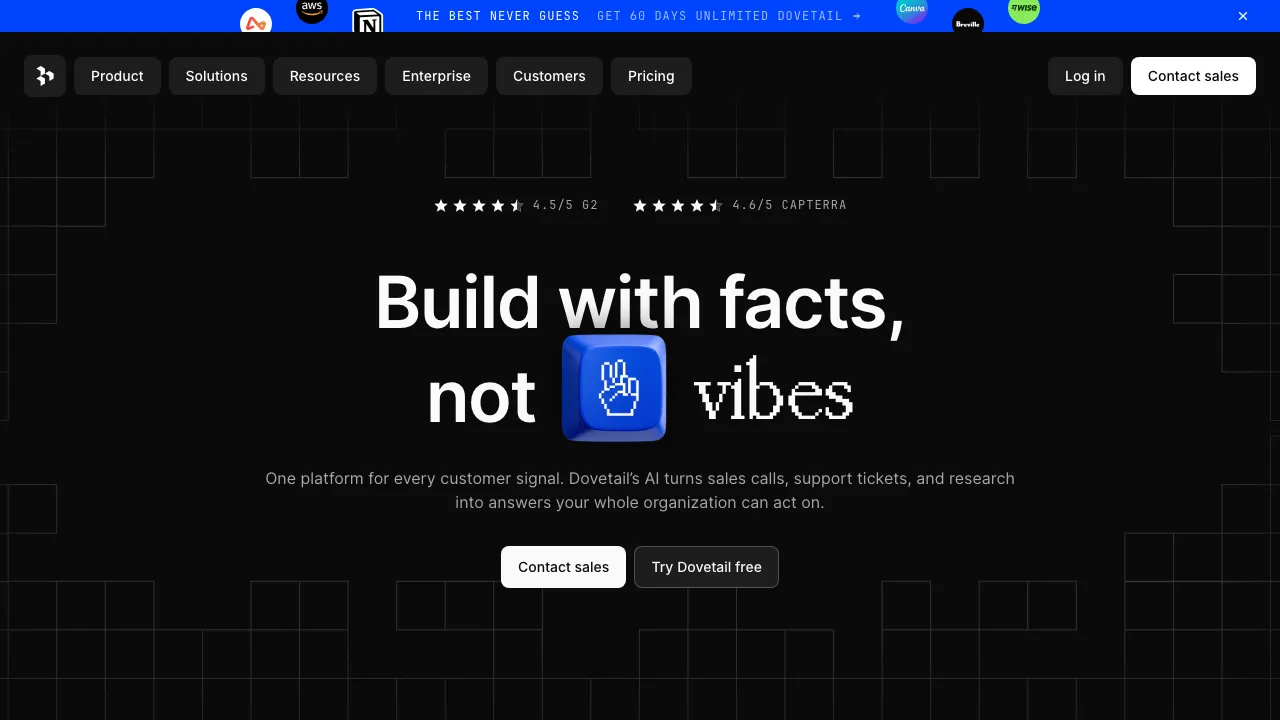
Dovetail might be the most loved product in the research stack, and the affection is earned: it's a genuinely elegant place to store, tag, and search qualitative data. But there's a sentence buried in every honest Dovetail review that changes the whole calculus: Dovetail does not conduct interviews or recruit participants. It's where research goes after it happens. If research isn't happening at your company, Dovetail is a beautiful library with no books.
What Dovetail actually is
Dovetail is a research repository. You upload recordings, transcripts, survey exports, and support tickets; it transcribes, lets you tag and highlight, clusters themes with AI, and makes everything searchable so insights don't die in someone's Google Drive. For a team with a dedicated researcher producing studies every month, it's the right system of record — that's exactly the team it was built for.
Reviewers' most common complaints are how fast it grows as you add seats and transcript hours, and caps that pinch smaller teams. But the structural issue isn't any of that. It's position in the pipeline: Dovetail starts working at the exact moment your hardest problem ends.
The Empty Repository Problem
Here's the loop most startup teams actually live: someone proposes "we should do more research." A repository gets bought, because organizing research feels like doing research. Three interviews get uploaded in week one. Then the sprint takes over — recruiting is slow, scheduling is painful, nobody has four spare hours to synthesize — and by month three the repository holds those same three interviews and a stale survey export. The tool didn't fail. The pipeline feeding it never existed.
A repository assumes a steady stream of raw research as input. The Maze 2025 report's most-cited research blocker — time and bandwidth, at 63% — is precisely the thing that cuts off that stream. Buying Dovetail without a research pipeline is buying a CRM with no leads.
The comparison
| Dovetail | Polyphon | |
|---|---|---|
| Category | Research repository | Automated interview infrastructure |
| Recruits participants | No | Yes — from Mixpanel/PostHog cohorts or CSV |
| Runs interviews | No | Yes — AI voice agent, 15-minute sessions |
| Transcription | Yes, for files you upload | Yes, built into every interview |
| Synthesis | AI clustering over your tags | Cross-interview themes with cited quotes, automatic |
| Output | Searchable repository | Linear/Jira tickets + daily Slack digest |
| Depends on you to | Collect all the data | Review scripts and read the digest |
| Setup | Import past studies you've collected | Connect analytics, set a goal, launch |
Where Dovetail is the right call
- You have a dedicated research team producing studies that need a governed system of record.
- You're consolidating years of existing research scattered across drives and decks.
- Multiple departments need to search past studies with permissions and structure.
Where Polyphon is different
Polyphon is the pipeline. It syncs a cohort from your analytics, sends the outreach from your own mailbox, runs the voice interviews, and synthesizes themes across sessions with quotes cited to the transcript. Then it does the part no repository attempts: it pushes the conclusion into your workflow — a prioritized ticket in Linear or Jira, a digest in Slack every morning. The deliverable isn't a better-organized archive. It's a decision your team can act on in the next standup.
The two tools aren't even mutually exclusive — plenty of teams will pipe Polyphon transcripts into a repository eventually. But the order matters. Generate the books first. Then worry about the library.
Frequently asked questions
Can I use Polyphon and Dovetail together?
Yes. Polyphon produces transcripts, recordings, and synthesized reports you can export into any repository. If you already run Dovetail, Polyphon fixes its input problem.
Doesn't Dovetail have AI analysis now?
It does, and it's good — but it analyzes what you upload. The bottleneck at most startups isn't analyzing collected data; it's that almost no data gets collected. Automation has to start before the upload step to matter.
What does Polyphon's synthesis look like?
Cross-interview pattern reports: recurring themes ranked by frequency and severity, each backed by cited quotes that link to the exact transcript moment, plus a suggested ticket your team can edit before it lands in Linear or Jira.
Stop guessing. Start knowing.
Polyphon interviews your real users, synthesizes the patterns, and files the ticket — automatically. The fastest way to see it is on your own users. Book a 15-minute call and we'll set up your first research goal live.
Book a callKeep reading
Polyphon vs. UserTesting: a panel of strangers vs. your actual users
UserTesting recruits a panel of professional testers. Polyphon interviews your actual users — recruited from your analytics, moderated by AI, synthesized into a ticket. Here's the honest comparison.
Polyphon vs. Maze: "does my design work" is not "why did they leave"
Maze validates designs before you ship. Polyphon finds out why users churn after you ship. Two different questions — and most teams only have bandwidth to answer one well.
Polyphon vs. User Interviews: recruiting was never the whole job
User Interviews gets participants onto your calendar. Then you moderate, transcribe, and synthesize every one of them. Polyphon automates the entire pipeline — from cohort to ticket.