Polyphon vs. Maze: "does my design work" is not "why did they leave"
Maze validates designs before you ship. Polyphon finds out why users churn after you ship. Two different questions — and most teams only have bandwidth to answer one well.
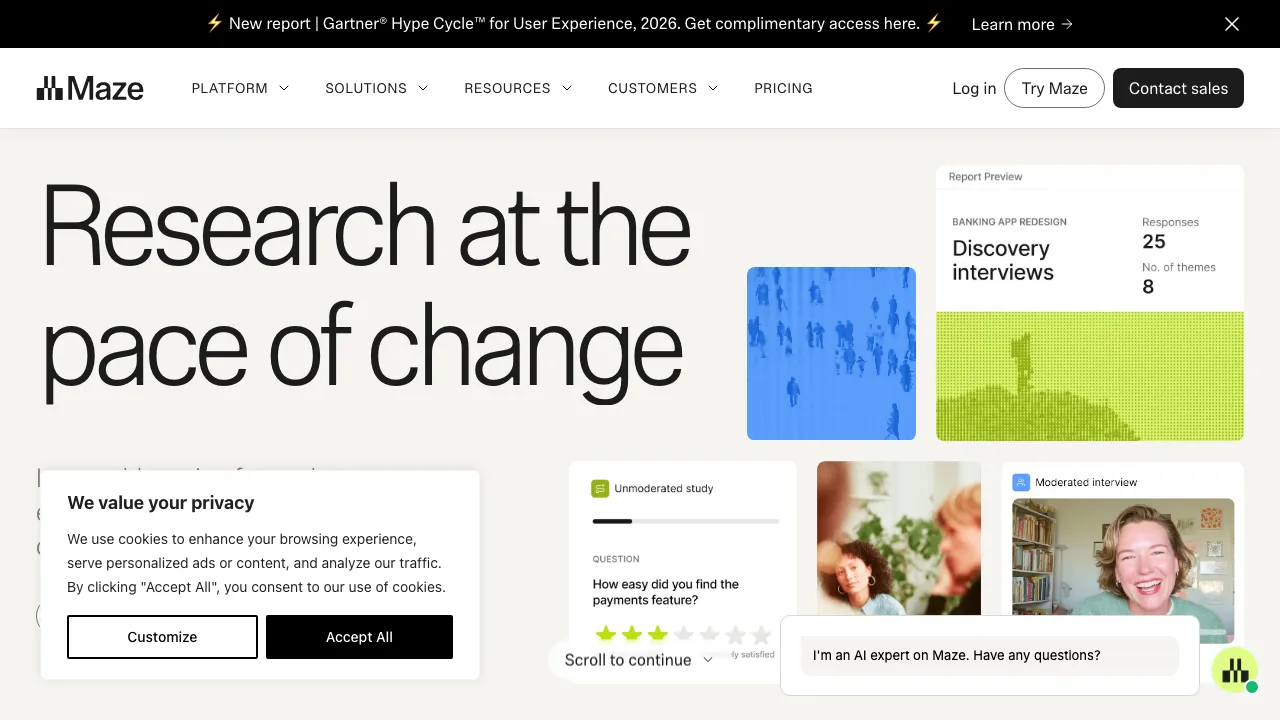
Maze is the tool that made usability testing feel modern: point it at a Figma prototype, push it to testers, and get click maps and completion rates before engineering writes a line of code. It's fast, it's quantitative, and design teams rightly love it. But Maze answers one question — does this design work? — and the question that actually decides a startup's fate is a different one: why are users leaving, and what would make them stay? That one needs a conversation, not a heatmap.
What Maze actually is
Maze is a product discovery and usability platform: prototype tests, card sorts, tree tests, five-second tests, and surveys, with analytics on top. It runs from self-serve up to enterprise, and for unmoderated validation of design decisions it's arguably the best self-serve tool in the market. Maze's own research arm even publishes the best data on this industry — their 2025 report is where the famous "63% of teams blocked by time and bandwidth" stat comes from.
The known rough edges — reviewers cite prototype crashes on mobile and limited conditional logic in surveys — are fixable product issues. The structural boundary isn't: nearly everything Maze measures happens before launch, with testers, on artifacts. Your churn happens after launch, with customers, in production.
The Prototype Gap
A usability test can prove a flow is learnable. It cannot prove anyone needs the feature or won't quietly stop using it in week three. Those are discovery questions, and they live in the heads of your real users — the ones with production data, a team that depends on the tool, and alternatives open in another tab. The teams that get burned aren't the ones who skipped usability testing. They're the ones who shipped a perfectly usable feature nobody wanted — the most damaging mistake in product, and the one usability testing structurally cannot catch.
The comparison
| Maze | Polyphon | |
|---|---|---|
| Core question | Does this design work? | Why do users churn, stall, or stay? |
| When it runs | Pre-launch, on prototypes | Continuously, on your live user base |
| Participants | Testers + panel | Your own users, targeted by cohort |
| Method | Unmoderated tasks, surveys | AI-moderated 15-min voice interviews |
| Depth | Quant metrics, short answers | Probing follow-ups, full conversations |
| Recruiting & outreach | You distribute or use panel | Automated from Mixpanel/PostHog/CSV |
| Output | Reports & metrics dashboards | Linear/Jira tickets + daily Slack digests |
| Built for | Designers validating prototypes | PMs explaining churn & retention |
Where Maze is the right call
- Validating a new flow in Figma before committing engineering time.
- Quick quantitative checks — first-click tests, tree tests, copy tests — at volume.
- Design teams that need usability metrics as a habit, sprint after sprint.
Where Polyphon is different
Polyphon starts where Maze's visibility ends: the moment a real user does something that matters in production. A churn event in Mixpanel or PostHog can trigger outreach the same day; a power-user cohort can get interviewed about the next quarter's roadmap while you build it. The AI voice agent runs a real conversation — it probes thin answers, chases the "why," and keeps the discussion on your research goal — and the synthesis lands as a cited, prioritized ticket in Linear or Jira with a Slack digest each morning. No test plan, no panel, no calendar.
Run both if you can: Maze to make sure the thing is usable, Polyphon to make sure the thing is *wanted*. But if you only have bandwidth for one question, ask the one that explains your retention.
Frequently asked questions
Doesn't Maze do interviews now too?
Maze has added interview studies and AI features, but the platform's center of gravity is unmoderated prototype and usability testing with quantitative output. Recruiting your own production users, automated outreach, voice moderation, and ticket delivery is not its pipeline.
Can Polyphon do usability testing?
Not Maze-style click maps — and we don't pretend to. Polyphon's interviews surface usability complaints in users' own words, but for pre-launch prototype validation, use a prototype testing tool.
What triggers an interview in Polyphon?
Cohorts you define from analytics — churned in the last 30 days, dropped off at a step, hit a usage milestone — or a list you upload. Polyphon handles the outreach, reminders, and the interview itself from there.
Stop guessing. Start knowing.
Polyphon interviews your real users, synthesizes the patterns, and files the ticket — automatically. The fastest way to see it is on your own users. Book a 15-minute call and we'll set up your first research goal live.
Book a callKeep reading
Polyphon vs. UserTesting: a panel of strangers vs. your actual users
UserTesting recruits a panel of professional testers. Polyphon interviews your actual users — recruited from your analytics, moderated by AI, synthesized into a ticket. Here's the honest comparison.
Polyphon vs. Dovetail: a beautiful library with no books
Dovetail organizes research you've already done. It doesn't recruit, interview, or collect anything. Polyphon runs the research itself — and ships the synthesis to Linear and Slack.
Polyphon vs. User Interviews: recruiting was never the whole job
User Interviews gets participants onto your calendar. Then you moderate, transcribe, and synthesize every one of them. Polyphon automates the entire pipeline — from cohort to ticket.