Polyphon vs. Listen Labs: the agency model, in AI clothing
Listen Labs wraps AI interviews in a managed, sales-led engagement scoped per project. Polyphon is self-serve and continuous, running in the background. Different models entirely.
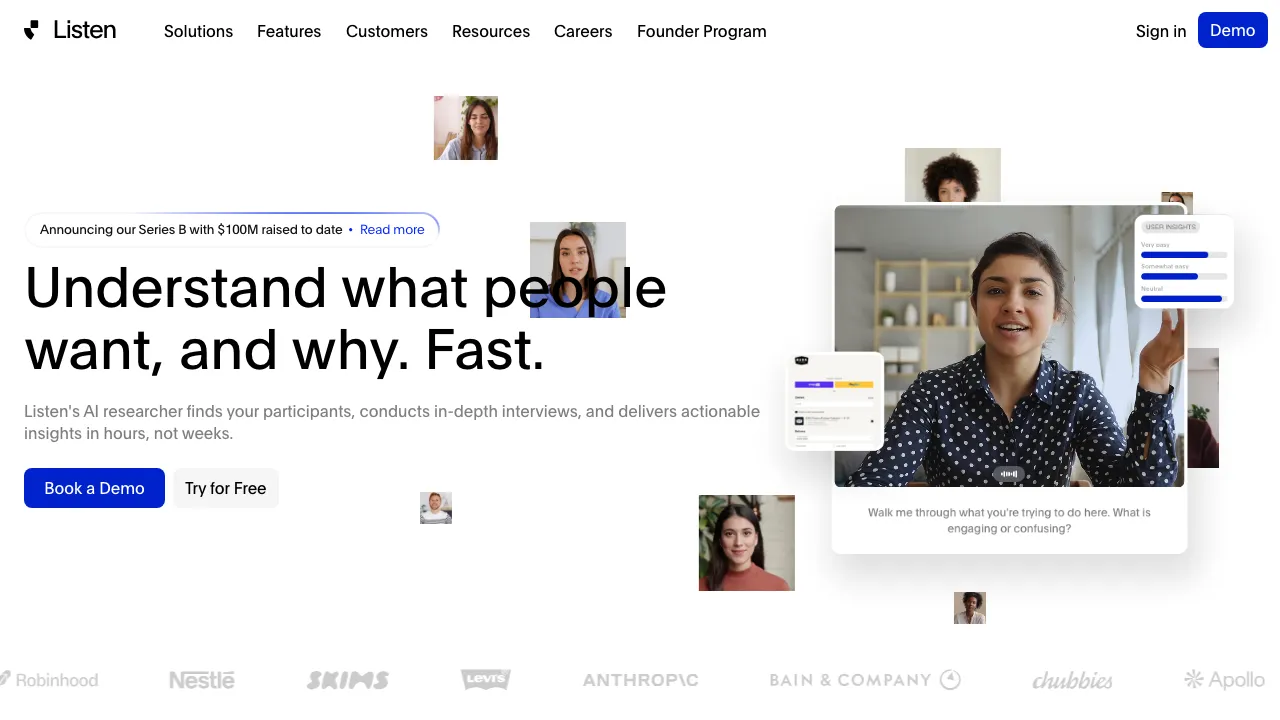
Listen Labs runs impressive AI-moderated interviews — and then sells them the old-fashioned way. Buyer reports describe a managed engagement: a sales conversation, an ops team that scopes audiences and screens participants for each project, and polished per-project deliverables at the end. That's not a self-serve product. That's a research agency with an AI moderator on staff. Whether that's right for you depends on a question most comparison pages skip: do you want research as a *project*, or as a *pipeline*?
What Listen Labs actually is
Listen Labs is an AI-led qualitative research platform aimed up-market. The AI conducts deep interviews at scale; their team handles recruitment operations — sourcing, screening, scheduling participants for each study — and the output arrives as polished per-project deliverables. For an enterprise insights team commissioning a major study, that white-glove wrapping is a feature: someone else does the operational work, and the report shows up.
But notice the shape of the engagement. Each study is scoped, staffed, and delivered. Research happens when a project is opened — which means research happens at the cadence of procurement, not the cadence of shipping.
The Project Trap
Project-based research has a failure mode every startup veteran has lived: the study answers last quarter's question. You scope it in March, field it in April, present it in May — and the roadmap moved twice in between. Continuous discovery exists precisely because product questions arrive weekly: *why did this cohort churn after the latest release? What stopped this week's signups from activating?* A scoped-study, ops-team-in-the-loop model structurally cannot run at that cadence — every additional question has a meeting attached.
The comparison
| Listen Labs | Polyphon | |
|---|---|---|
| Model | Managed engagements, per project | Self-serve software, always on |
| Buying motion | Sales-led, scoped studies | Sign up, connect analytics, launch |
| Time to launch | Per-study scoping & screening | Self-serve, same day |
| Recruiting | Their ops team, per study | Automated from your Mixpanel/PostHog cohorts |
| Cadence | Project cycles | Continuous — triggered by user behavior |
| Asking one more question | A scoped decision each time | Just another cohort rule |
| Delivery | Per-project deliverables | Linear/Jira tickets + daily Slack digest |
| Best fit | Enterprise insights teams | Startup product teams shipping weekly |
That row is the whole strategy in one line. When every interview is a scoped, billed event, each one is a deliberate decision; someone has to believe in the question before anyone asks it. When the marginal interview is just another cohort rule, you interview by default — every churn, every milestone, every launch — and the surprising answers come from the questions nobody would have bothered to scope.
Where Listen Labs is the right call
- You're an enterprise insights team with appetite for commissioned studies and a preference for managed delivery.
- Your study needs external participants sourced and screened by someone else.
- You want a vendor-run engagement you can hand to procurement, not another tool to operate.
Where Polyphon is different
Polyphon replaces the ops team with software. Cohorts sync from your analytics; outreach runs from your own mailbox; the voice agent interviews; synthesis lands in Linear, Jira, and Slack — continuously, without a scoping call. It's the difference between commissioning research and *having* research, the way you have CI: always running, set up once, taken for granted until you remember what life was like without it.
Frequently asked questions
Is managed research ever the right call?
Yes — for one-off strategic studies with unfamiliar audiences, having experts run the whole operation makes sense. It stops making sense for the recurring, own-user questions that come up every sprint.
How does Polyphon handle recruiting without an ops team?
Your analytics already know who to talk to. Polyphon syncs Mixpanel or PostHog cohorts (or a CSV), generates outreach you approve once, and handles sending, nudges, and the interview link end to end.
What about interview quality without human screening?
Cohort targeting is the screening: you're interviewing people whose actual product behavior qualified them. The agent then verifies context conversationally before going deep — closer to how a good researcher screens in the first two minutes anyway.
Stop guessing. Start knowing.
Polyphon interviews your real users, synthesizes the patterns, and files the ticket — automatically. The fastest way to see it is on your own users. Book a 15-minute call and we'll set up your first research goal live.
Book a callKeep reading
Polyphon vs. UserTesting: a panel of strangers vs. your actual users
UserTesting recruits a panel of professional testers. Polyphon interviews your actual users — recruited from your analytics, moderated by AI, synthesized into a ticket. Here's the honest comparison.
Polyphon vs. Dovetail: a beautiful library with no books
Dovetail organizes research you've already done. It doesn't recruit, interview, or collect anything. Polyphon runs the research itself — and ships the synthesis to Linear and Slack.
Polyphon vs. Maze: "does my design work" is not "why did they leave"
Maze validates designs before you ship. Polyphon finds out why users churn after you ship. Two different questions — and most teams only have bandwidth to answer one well.