Polyphon vs. Outset: enterprise research, enterprise everything
Outset brought AI-moderated research to enterprise insights teams — seat-bound, sales-led, built for planned studies. Polyphon is the startup-native version: self-serve, continuous, and pointed at your own users.
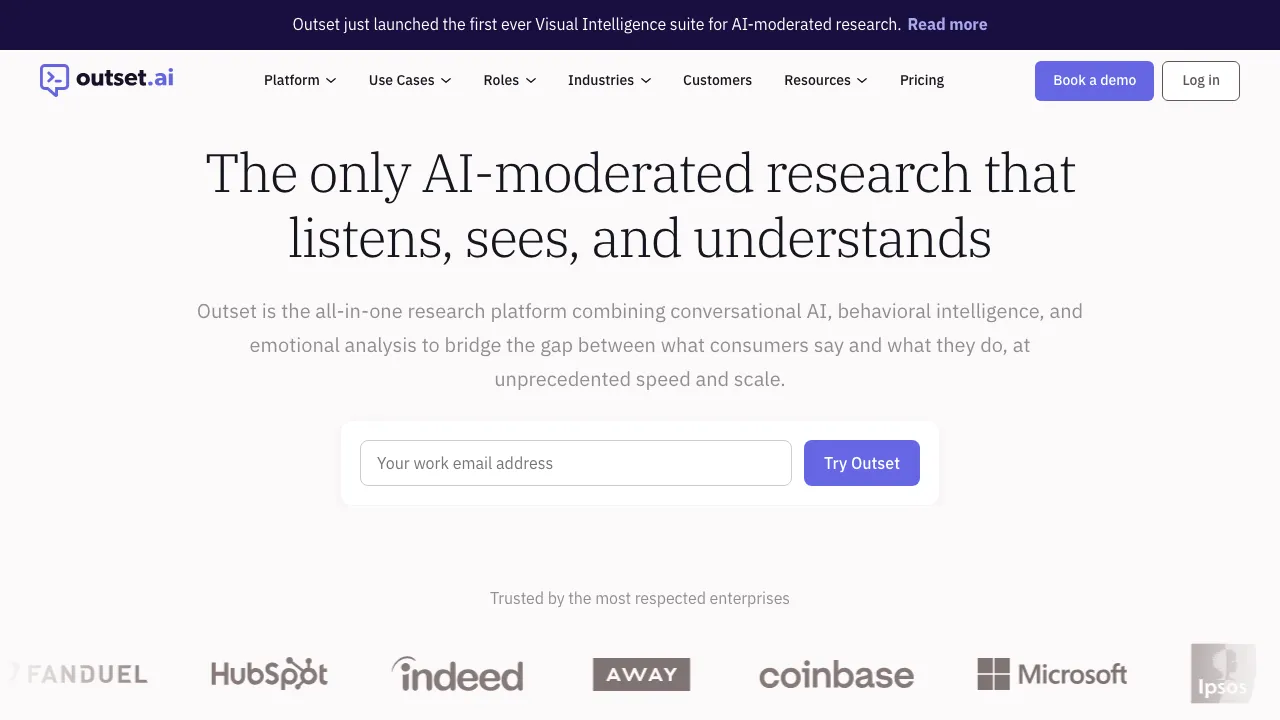
Outset was one of the first companies to prove the thesis this whole category now runs on: an AI can moderate a research session, and participants will open up to it. Real credit for that. But Outset took the thesis up-market — sold by the seat, sales-led, enterprise-deployed — and what works for a Fortune 500 insights team is structurally wrong for a 30-person startup that needs to know why Tuesday's cohort churned. Same technology bet, opposite product.
What Outset actually is
Outset is an AI-moderated research platform for enterprise insights and UX teams: structured studies, video and survey formats, multilingual moderation, synthesis across sessions, and the security and procurement posture large organizations require. Reports describe its async video studies as consistent by design — every participant gets the same prompts — which enterprises often want for comparability across large samples.
That consistency cuts both ways: less adaptive probing when a participant says something unexpected — and the unexpected answer is usually the one worth chasing. Combined with per-seat access and a sales cycle, the product's center of gravity is clear: planned studies, run by research professionals, inside companies with a dedicated insights function.
The Rationed-Seat Problem
Per-seat access rations curiosity. The seat goes to the insights lead — and every PM, designer, and founder with a question becomes a ticket in the insights team's queue. The questions that drive startup roadmaps ("why did activation dip this week?") are exactly the ones that die in a queue: too small to scope, too urgent to wait. By the time the study runs, the sprint shipped. It's the agency cadence problem in software form.
The comparison
| Outset | Polyphon | |
|---|---|---|
| Built for | Enterprise insights & UXR teams | Startup product teams |
| Buying motion | Sales-led, procurement | Self-serve, live in an afternoon |
| Access | Per-seat, rationed to research | Whole team, no seats |
| Interview style | Structured, consistent prompts | Adaptive voice — probes the unexpected |
| Recruiting | You supply or integrate panels | Auto-synced from Mixpanel/PostHog/CSV |
| Cadence | Planned studies | Continuous, behavior-triggered |
| Delivery | Research reports & dashboards | Linear/Jira tickets + daily Slack digest |
| Who asks questions | The research function | Anyone on the team, any week |
Where Outset is the right call
- You're an enterprise with a staffed insights function, procurement requirements, and large planned studies.
- You need strict prompt consistency across hundreds of participants for comparability.
- Multilingual, multi-format studies at global scale are your norm, not your edge case.
Where Polyphon is different
Polyphon is what this technology looks like when it's built startup-native from the first commit. No seats to ration — one workspace covers the whole team. No studies to scope — cohorts from your analytics trigger interviews continuously. No queue — the PM with the question connects the cohort and reads the digest. The voice agent is adaptive on purpose: when a churned user drops the sentence you didn't expect, the agent follows it, because at a startup the unexpected sentence *is* the research finding.
Frequently asked questions
Aren't Polyphon and Outset using the same underlying AI?
The conversation layer draws on the same generation of models industry-wide. The difference is everything around it: who gets recruited and how, what triggers a study, where insights land, and what it takes to ask one more question. That's product architecture, not model choice.
Can Polyphon handle enterprise requirements?
Polyphon is built for Series A–C product teams: self-serve, your-mailbox outreach, and workspace-level controls. If your procurement checklist runs to SSO mandates and security reviews measured in quarters, an enterprise platform is honestly the better fit today.
What does 'continuous' mean concretely?
Standing cohorts — churned users, stalled onboarders, power users — are interviewed as people enter them, every week, without anyone kicking off a study. The Slack digest each morning is the heartbeat.
Stop guessing. Start knowing.
Polyphon interviews your real users, synthesizes the patterns, and files the ticket — automatically. The fastest way to see it is on your own users. Book a 15-minute call and we'll set up your first research goal live.
Book a callKeep reading
Polyphon vs. UserTesting: a panel of strangers vs. your actual users
UserTesting recruits a panel of professional testers. Polyphon interviews your actual users — recruited from your analytics, moderated by AI, synthesized into a ticket. Here's the honest comparison.
Polyphon vs. Dovetail: a beautiful library with no books
Dovetail organizes research you've already done. It doesn't recruit, interview, or collect anything. Polyphon runs the research itself — and ships the synthesis to Linear and Slack.
Polyphon vs. Maze: "does my design work" is not "why did they leave"
Maze validates designs before you ship. Polyphon finds out why users churn after you ship. Two different questions — and most teams only have bandwidth to answer one well.