Polyphon vs. Sprig: a thousand five-word answers
Sprig captures in-the-moment microsurvey feedback at huge volume. But 'it was confusing' isn't an insight. Polyphon trades breadth for 15 minutes of depth — here's when each wins.
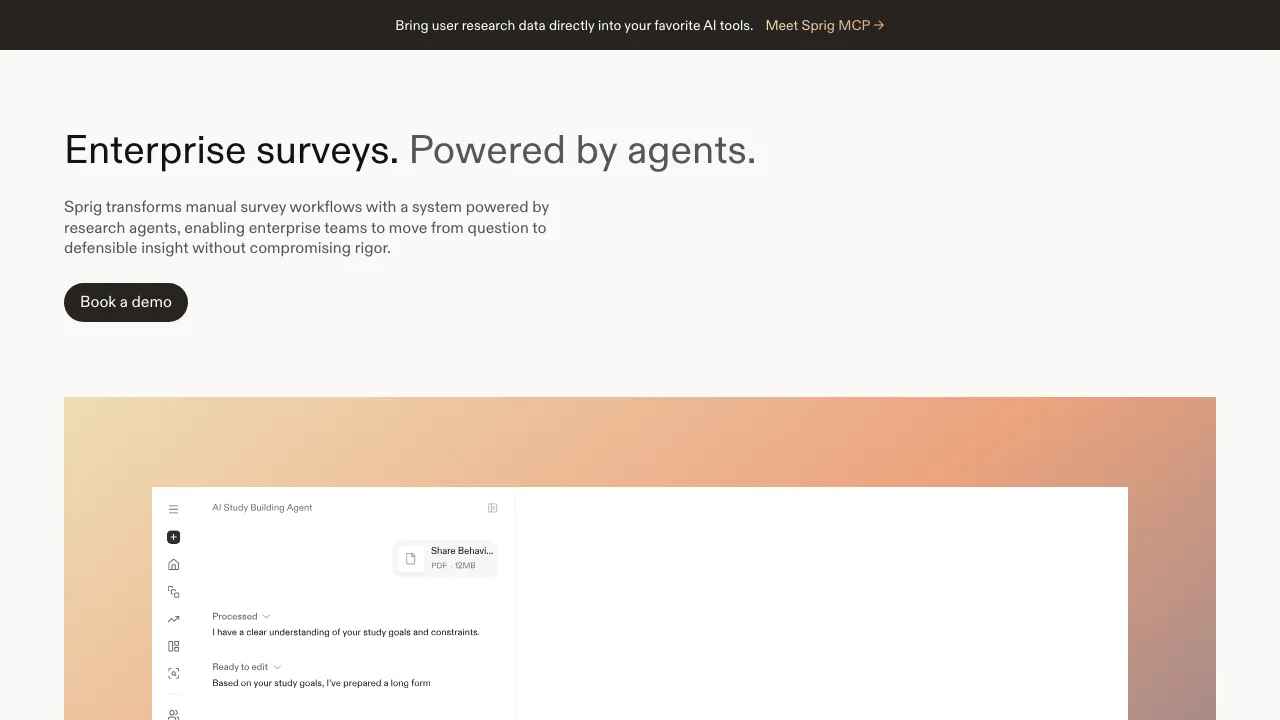
Sprig perfected the art of asking one question at the perfect moment. A user abandons checkout, a survey slides in, and by Friday you have eight hundred responses to "What stopped you today?" That's a real capability and Sprig executes it beautifully. The trouble is what's *in* those eight hundred responses: "too slow." "confusing." "just looking." A thousand five-word answers will tell you where the problem is. They almost never tell you what it actually is — and the gap between those two is where roadmaps go wrong.
What Sprig actually is
Sprig is an in-product survey and feedback platform: behaviorally-triggered microsurveys, session replay, feedback widgets, and AI that clusters open-text responses into themes. It's the right tool for continuous pulse-taking on live surfaces — NPS in context, feature satisfaction at the moment of use, funnel-exit one-liners. Reviewers consistently praise the targeting; the behavioral triggers are the best in the category.
And to be fair to Sprig: they know what the tool is. It's a breadth instrument. The constraint isn't bad design — it's physics. A survey that interrupts a live session must be answerable in seconds, and anything answerable in seconds can only be answered shallowly.
The Shallow Data Trap
Here's how shallow data quietly damages good teams: "confusing" tops the churn survey, so the team simplifies the UI — but ten real conversations would have revealed users meant *"I never found the one feature I came for,"* which is a discovery and onboarding problem, not a UI problem. The redesign ships, effort burns, churn doesn't move. Survey data is a symptom report. Treatment decisions need the diagnostic interview — the follow-up question, the "tell me more," the pause where the user finds the real answer behind their first answer.
The comparison
| Sprig | Polyphon | |
|---|---|---|
| Instrument | In-product microsurveys + replays | AI-moderated 15-min voice interviews |
| Signal type | Breadth — hundreds of short answers | Depth — full conversations with follow-ups |
| Moment | In-session, in the flow | Post-event, when users can reflect |
| Follow-up questions | Limited branching | Adaptive probing on every thin answer |
| Best at | Where is the problem? | What is the problem, and why? |
| Targeting | In-product behavior triggers | Analytics cohorts (Mixpanel/PostHog) + CSV |
| Output | Dashboards, clustered themes | Cited synthesis → Linear/Jira + Slack digest |
| Reach | Active users in the product | Includes churned users who never log in again |
That last row deserves a highlight: your most important research subjects — churned users — never see an in-product survey, because they're not in the product. The people with the most valuable feedback are structurally invisible to in-session tools. Polyphon reaches them by email, where they still exist.
Where Sprig is the right call
- Continuous pulse metrics — CSAT, NPS, PMF surveys — across thousands of active users.
- Catching feedback in the moment of friction, before the user rationalizes it away.
- Quantifying how widespread a known issue is across segments.
Where Polyphon is different
Polyphon is the diagnostic layer. When a cohort matters — churned this month, dropped at onboarding step three, power users pre-renewal — Polyphon reaches out by email from your own mailbox, runs a real voice conversation that chases every "it was confusing" down to the actual moment of confusion, and synthesizes across interviews with quotes cited to the recording. The conclusion lands in Linear or Jira as a ticket, with a Slack digest every morning. Where Sprig counts symptoms, Polyphon explains them.
The honest play for a well-funded team is both: Sprig to detect and quantify, Polyphon to diagnose and decide. If you have to pick one and your roadmap questions start with "why," pick depth.
Frequently asked questions
Can't Sprig's AI analysis extract the 'why' from open text?
It clusters what users typed — but a five-word answer contains five words of signal, however good the clustering. No analysis layer can recover the follow-up question nobody asked. Depth has to be captured at collection time.
Isn't a 15-minute interview a bigger ask than a microsurvey?
Per user, yes — which is why response volume is lower and per-response value is dramatically higher. Polyphon needs ten good conversations, not eight hundred fragments, to find the pattern that changes a roadmap. Different sampling for a different job.
Does Polyphon do in-product surveys?
No. Polyphon does one thing: automated voice interviews with your own users, from cohort to ticket. Teams that need in-session pulse metrics should keep a survey tool alongside it.
Stop guessing. Start knowing.
Polyphon interviews your real users, synthesizes the patterns, and files the ticket — automatically. The fastest way to see it is on your own users. Book a 15-minute call and we'll set up your first research goal live.
Book a callKeep reading
Polyphon vs. UserTesting: a panel of strangers vs. your actual users
UserTesting recruits a panel of professional testers. Polyphon interviews your actual users — recruited from your analytics, moderated by AI, synthesized into a ticket. Here's the honest comparison.
Polyphon vs. Dovetail: a beautiful library with no books
Dovetail organizes research you've already done. It doesn't recruit, interview, or collect anything. Polyphon runs the research itself — and ships the synthesis to Linear and Slack.
Polyphon vs. Maze: "does my design work" is not "why did they leave"
Maze validates designs before you ship. Polyphon finds out why users churn after you ship. Two different questions — and most teams only have bandwidth to answer one well.